Electronic music is any music created or modified primarily through electronic instruments, synthesizers, computers, and digital technology rather than traditional acoustic instruments. It’s a vast sonic landscape that spans nearly a century, from early experiments with magnetic tape to the glitch-hop producer crafting beats in their bedroom right now.
If you’re diving into electronic music for the first time, you’re entering one of the most diverse and boundary-pushing genres in modern sound. This isn’t just about the EDM acts that dominate festival lineups (though they’re part of the story). The real depth lies in the underground currents: labels pressing limited-run vinyl in Berlin basements, artists manipulating modular synths in Tokyo warehouses, and bedroom producers in São Paulo inventing microgenres that might never chart but shape how we think about rhythm and texture.
The beauty of electronic music is its accessibility as both listener and creator. You don’t need formal training or a full band to start making it. A laptop, some software, and curiosity can open doors to sound design that would’ve required a million-dollar studio forty years ago. Yet mainstream recognition often bypasses the innovators, missing the best artists who push the genre forward from the fringes.
This guide breaks down what electronic music actually is, how producers craft it, the sprawling subgenres you should know, and surprising facts about its history and evolution. Whether you’re here to understand the basics or uncover obscure corners worth exploring, we’re covering the essential knowledge that connects vintage analogue warmth to cutting-edge algorithmic composition.
What Electronic Music Actually Means
Electronic music is any music created primarily through electronic devices and technology rather than acoustic instruments. At its core, the electronic music definition centres on sound generation: if the audio originates from oscillators, circuits, or software instead of vibrating strings, membranes, or air columns, you’re hearing electronic music. This might seem straightforward, but the genre’s scope is vast, from pulsing techno built on drum machines to ambient soundscapes sculpted entirely in code.
What separates electronic music from traditional forms isn’t just the gear. It’s the creative freedom that comes with manipulating sound at its fundamental level. A guitarist plucks strings; an electronic producer designs the waveform itself, shaping tone, timbre, and rhythm through technology. The tools define the genre’s identity:
- Synthesizer
- An instrument that generates sound electronically using oscillators and filters, allowing producers to create tones that don’t exist in nature.
- Drum Machine
- A device that produces programmed percussion sounds, giving electronic tracks their rhythmic backbone without needing a live drummer.
- Sequencer
- Software or hardware that arranges musical patterns in time, automating melodies and beats with precise control.
- DAW (Digital Audio Workstation)
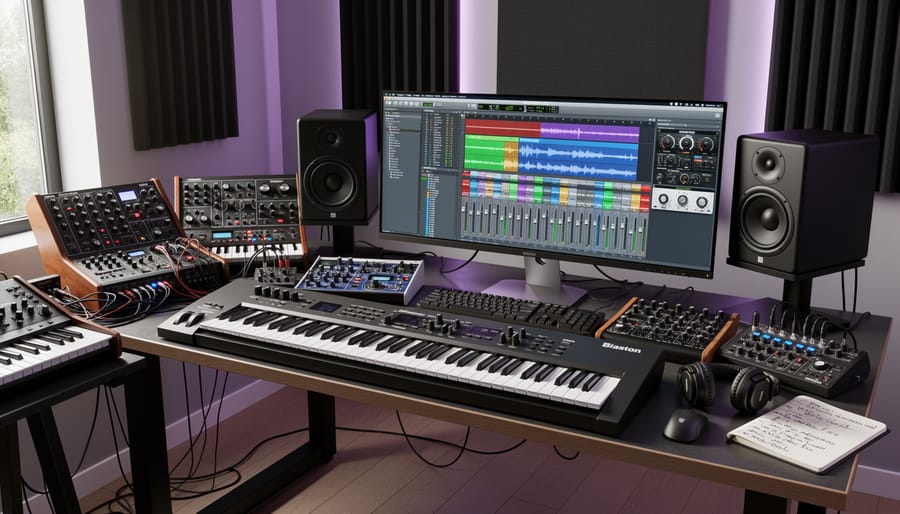
- The central production environment where producers record, edit, and mix tracks on a computer, replacing traditional recording studios.
- Sampling
- The process of recording existing sounds and repurposing them as instruments or textures within a new composition.
These tools don’t just reproduce music, they fundamentally alter how it’s conceived and constructed. Unlike a band recording live takes in a studio, electronic music often emerges through layering, looping, and digital sculpting. A single producer with a laptop can access the same sonic palette that once required rooms full of analogue equipment, which explains why the genre has exploded in diversity and accessibility. Whether it’s minimal techno built on three repeating elements or dense IDM constructed from hundreds of micro-edits, the unifying thread is technology as the primary instrument.
How Electronic Music Production Works
Sound Generation and Synthesis
Electronic instruments generate sound through electromagnetic circuits rather than strings, reeds, or vibrating air columns. At the heart of this process sits the oscillator, an electronic component that produces repeating waveforms at specific frequencies. These waveforms come in distinct shapes: sine waves create pure, flute-like tones; sawtooth waves sound bright and buzzy; square waves deliver hollow, clarinet-style timbres. By adjusting an oscillator’s frequency, you control pitch; by selecting its waveform, you shape the fundamental character of the sound.
Filters then sculpt these raw waveforms by removing or emphasizing certain frequencies. A low-pass filter cuts high frequencies to create warm, muffled tones, while a high-pass filter does the opposite, producing thin, airy sounds. The filter’s resonance control adds emphasis at the cutoff point, creating the sweeping, vocal-like effects heard in classic synthesizer leads.
Modulators add movement and complexity. An envelope generator controls how a sound evolves over time, how quickly it attacks, how long it sustains, and how it fades. Low-frequency oscillators create rhythmic wobbles, vibrato, or pulsing filter sweeps. Together, these components let producers design sounds that don’t exist in nature: metallic drones, glitchy percussive clicks, or evolving atmospheric textures that shift across minutes without repeating.
Sequencing and Rhythm Programming
Sequencing transforms electronic music from random sounds into structured rhythm. At its core, a step sequencer divides musical time into precise steps, typically 16 beats per bar, allowing producers to program exactly when each drum hit, bass note, or synthesizer pulse occurs. Unlike acoustic drummers who perform in real time, electronic musicians build rhythm patterns step by step, triggering sounds with mathematical precision or introducing subtle timing variations to mimic human feel.
Drum machines changed how rhythm works in electronic music. The Roland TR-808, released in 1980, offered 16 programmable steps and became the backbone of countless tracks despite initially failing commercially. Modern producers still use step sequencing, though today’s digital audio workstations provide infinite steps and microscopic timing control. You can shift a hi-hat by milliseconds to create groove, or lock every element to a rigid grid for mechanical intensity.
MIDI (Musical Instrument Digital Interface) connects these components. Introduced in 1983, MIDI doesn’t transmit audio, it sends instructions about which notes to play, when, and how hard. A single MIDI sequence can control dozens of synthesizers simultaneously, letting producers build complex polyrhythmic layers where each instrument follows different but synchronized patterns. This interoperability explains why bedroom producers can create dense, club-ready tracks with minimal equipment. The rhythm programming tools that once required hardware racks now run entirely in software, democratizing access to the same sequencing precision that underground artists use to craft hypnotic, evolving grooves.
Main Types and Subgenres of Electronic Music
Electronic music splits into dozens of subgenres, each with its own rhythmic signatures, production techniques, and cultural roots. While most people recognize house and techno as the genre’s heavyweights, the real excitement lives in the fringes where producers experiment with unconventional structures and sonic textures.
House emerged from Chicago in the 1980s, built on four-on-the-floor kick patterns and soulful samples. Techno followed from Detroit, stripping away house’s warmth for something more mechanical and futuristic. These two pillars spawned countless variations, but they’re just the entry point.
Dig deeper and you’ll find styles that challenge what dance music can be:
- Ambient, slowly evolving soundscapes designed for contemplation rather than movement, pioneered by Brian Eno and expanded by artists like Biosphere
- IDM (Intelligent Dance Music), complex, cerebral electronic music from labels like Warp Records that prioritizes experimentation over club functionality
- Breakcore, aggressive, hyperkinetic genre built on chopped breakbeats, distortion, and tempo shifts that can hit 200+ BPM
- Vaporwave, internet-born style sampling 1980s and 1990s corporate music, creating surreal nostalgia through pitch-shifting and reverb
- Hardgroove, minimal techno variant with stripped-down, hypnotic loops that build tension through subtle variations
- Lowercase, ultra-minimalist approach using barely audible sounds, environmental recordings, and extended silences
- Witch House, dark, occult-themed electronic music combining slowed hip-hop beats with horror movie atmospherics
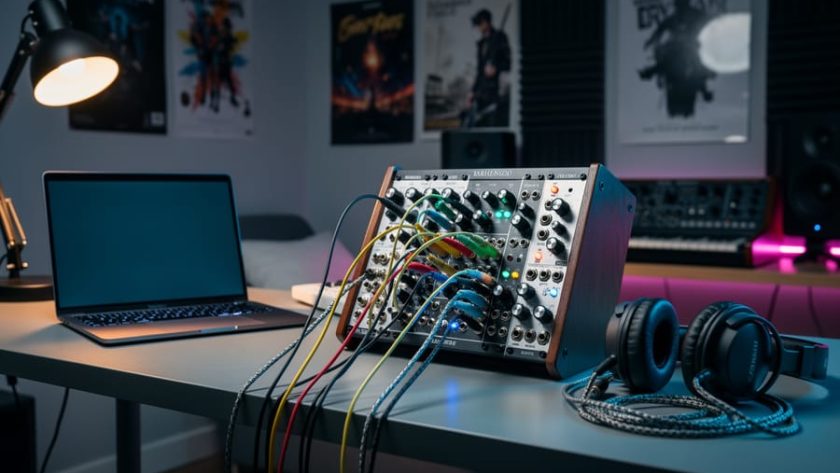
Beyond these, smaller micro-genres keep emerging from bedroom producers and underground collectives. Footwork from Chicago emphasizes frantic, syncopated rhythms around 160 BPM. UK bass music encompasses dubstep, grime, and UK garage, each with distinct production characteristics. Modular synthesis has birthed its own experimental community, where artists build custom instruments and share patch techniques online.
The boundaries between subgenres blur constantly. A producer might blend ambient textures with techno’s drive, creating something that fits neither category cleanly. This fluidity keeps electronic music vital, it rewards curiosity and resists easy categorization. Independent artists often work across multiple styles within a single release, treating subgenre labels as rough guides rather than rigid rules. That’s where the most interesting discoveries happen, in the spaces between established categories where producers follow their own instincts.
Where Electronic Music Is Used and Applied
Electronic music broke free from nightclubs decades ago and now shapes how we experience sound across dozens of creative fields. Film composers layer droning synthesizers under tense thriller scenes or build entire sci-fi soundscapes from modular rigs, creating atmospheres that acoustic orchestras can’t touch. Hans Zimmer’s Blade Runner 2049 score leans heavily on analog synths to evoke dystopian futures, while smaller independent filmmakers use accessible digital workstations to craft equally immersive sonic worlds on minimal budgets.
Video games have become one of electronic music’s most expansive playgrounds. From the chiptune heritage of early console soundtracks to today’s adaptive scores that shift in real time based on player actions, electronic production offers the flexibility and programmability that interactive media demands. Ambient electronic tracks loop seamlessly for hours in open-world exploration games, while percussive techno drives racing titles and combat sequences.
Art galleries and installations frequently employ electronic music for its capacity to fill physical space with evolving sound. Artists build site-specific compositions using field recordings, granular synthesis, and generative algorithms that create non-repeating audio experiences. Some installations let viewers trigger sounds by moving through the space, turning the audience into performers.
Meditation apps and therapeutic contexts use ambient electronic music for its sustained tones and absence of lyrical distraction. Slow-moving pads, gentle arpeggios, and carefully sculpted noise create immersive soundbaths that help listeners focus or relax. Independent artists explore binaural beats and tuning systems outside standard Western scales, investigating how specific frequencies affect mood and perception.
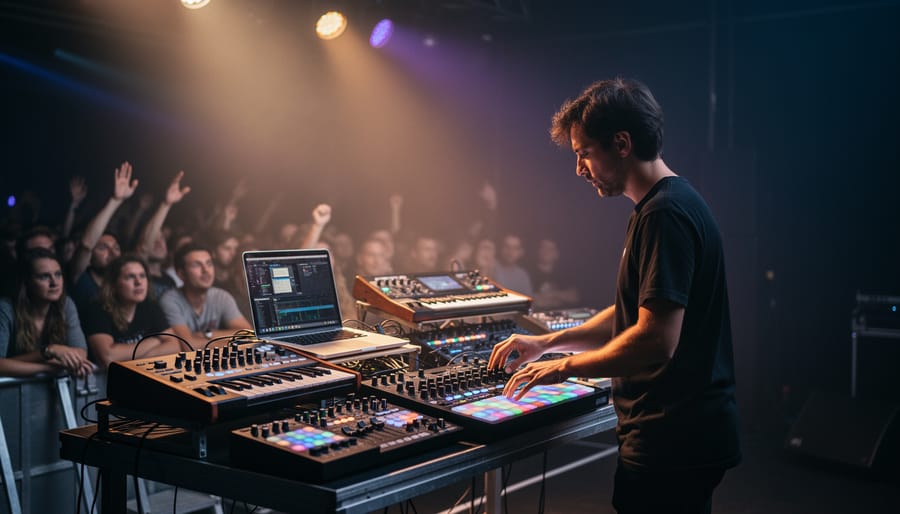
Experimental performance artists use electronic tools to manipulate voice, objects, and environmental sounds in real time, turning concerts into unpredictable sonic events. Modular synthesizers, loopers, and custom Max/MSP patches let one person generate complex, shifting compositions onstage. This creative flexibility is why electronic music has become the default toolkit for sonic explorers working outside traditional genre boundaries.
Surprising Historical Facts About Electronic Music
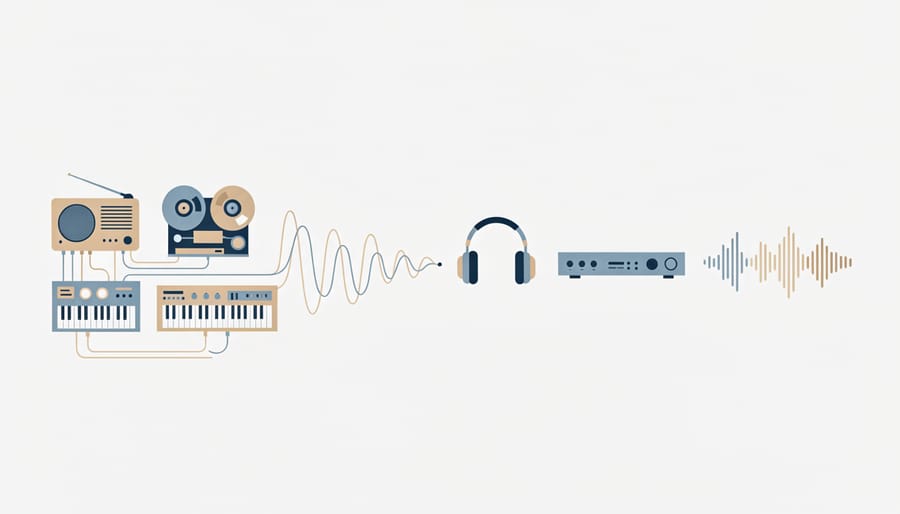
Electronic music’s timeline stretches back further than most people realize. The theremin, invented in 1920 by Russian physicist Lev Termen, predates rock and roll by decades. This eerie, touchless instrument, played by moving hands near two antennae, appeared in everything from classical compositions to sci-fi film scores, proving that electronic sound generation fascinated audiences long before synthesizers became household names.
The 1940s brought musique concrète, a radical French movement where composers like Pierre Schaeffer manipulated recorded sounds, slamming doors, train wheels, voices, using tape loops and speed alterations. This wasn’t music made with traditional instruments; it was sound itself becoming the raw material. These experiments laid conceptual groundwork for sampling and sound design techniques that independent producers still explore today.
The Moog synthesizer’s 1964 debut revolutionized accessible electronic sound creation, but affordability remained elusive. The real democratization came with the Roland TR-808 drum machine (1980) and TB-303 bass synthesizer (1982), both initially commercial failures that became foundational to house, techno, and hip-hop after musicians discovered their unique sonic character. Suddenly, bedroom producers could craft full tracks without expensive studio time or traditional instrumental training.
By the 1990s, software like Cubase and later Ableton Live turned laptops into complete production studios. This accessibility explosion transformed electronic music from a niche experimental pursuit into a global phenomenon where a teenager in Jakarta could create tracks that rivaled professional studios. The genre’s facts reveal a continuous thread: each technological advancement made electronic music creation more accessible, spawning new subgenres and drawing in artists who would never have picked up a guitar.
When exploring how underground artists craft their work, whether through album review examples or debates about perfect album length remember that today’s bedroom producer inherits a century-long legacy of sonic experimentation and technological rebellion.
Common Questions About Electronic Music
Does electronic music require expensive equipment?
Not at all. While high-end synthesizers and controllers exist, you can start making electronic music with just a laptop and free software like Reaper or VCV Rack. Many groundbreaking tracks have been created with minimal gear, proving that what works is creativity and experimentation, not budget.
Can electronic music be made without computers?
Yes, and it was for decades. Early electronic pioneers used tape manipulation, theremins, and analogue synthesizers in the 1950s and 60s. Even today, artists build entire albums using modular synths, drum machines, and sequencers with no digital component whatsoever.
What’s the difference between electronic music and EDM?
Electronic music is the broad umbrella covering anything made with electronic instruments, from ambient soundscapes to industrial noise. EDM refers specifically to dance-oriented electronic styles like big-room house, dubstep, and festival trap, usually designed for clubs and large events.
Is electronic music considered a legitimate genre?
Absolutely. Electronic music has earned widespread genre recognition across academia, the music industry, and cultural institutions, with dedicated Grammy categories, university programs, and museum exhibitions celebrating its innovation and influence.
These questions come up constantly because electronic music still feels mysterious to listeners raised on traditional instruments. The good news is that the barrier to entry has never been lower. You can sketch out ideas on a smartphone, learn sound design through YouTube tutorials, and share finished tracks online within days. The creative possibilities extend far beyond club bangers, too. Artists use electronic production for film scoring, meditation tracks, field recording collages, and avant-garde performances that blur the line between music and installation art. If you’re curious about diving in, start by listening widely to obscure subgenres and independent producers who treat electronic tools as paintbrushes rather than formulas. The genre rewards curiosity and risk-taking more than technical perfection.
Electronic music remains one of the most dynamic and boundary-pushing genres precisely because it refuses to stand still. From its foundations in sound synthesis and rhythm programming to its sprawling family of subgenres and experimental offshoots, the facts about electronic music reveal a creative landscape built on both technical innovation and artistic risk-taking. Whether you’re drawn to the hypnotic repetition of minimal techno, the ambient textures of drone music, or the glitchy complexity of IDM, there’s an entire universe of sonic exploration waiting beyond the mainstream.
Underground Beats exists to help you navigate that universe. Our curated compilations spotlight the independent producers and obscure artists who are redefining what electronic music can be right now, in 2026. These are the musicians working in their home studios, crafting sounds you won’t hear on commercial playlists, pushing synthesizers and samplers into uncharted territory. If you’ve enjoyed learning these facts about electronic music and want to hear where the genre is heading next, dive into our exclusive compilations. You’ll discover tracks that challenge conventions, surprise your ears, and prove that electronic music’s most exciting work is often happening in the underground.