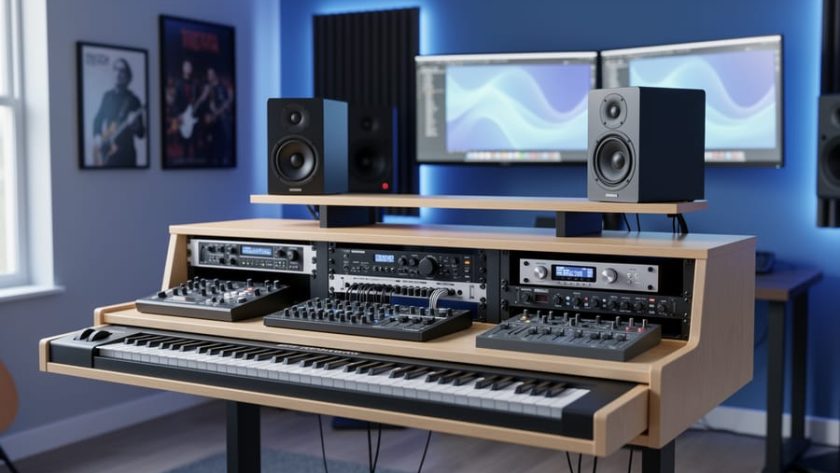
A music production desk is purpose-built furniture designed to organize your studio gear, improve workflow, and position monitors at the optimal listening height. If you’re setting up a home studio in 2026, the Output Platform stands out as the best choice for most producers, combining 100% birch wood construction, 9U of rack space, an 88-key keyboard tray, and a monitor bridge that puts your speakers exactly where they need to be.
Unlike a standard office desk, these workstations account for the unique demands of modern production. You need space for MIDI controllers, audio interfaces, outboard compressors, and multiple screens. You need rack mounting for your gear. You need cable management that doesn’t turn into a rat’s nest every time you patch in a new synth. The right desk transforms a cluttered bedroom corner into a focused creative space where everything is within arm’s reach.
The market has exploded with options. Budget-conscious producers can start with the On-Stage WS7500 and still get proper rack space. If you’re drowning in outboard gear, the Argosy Dual 15 offers serious expansion, while the Gustav Sessiondesk delivers 18U of rack mounting without the premium price tag. For minimal setups, even a simple Project 62 Loring Wood Writing Desk works when paired with desktop stands. Those embracing the standing desk movement can spec an UPLIFT Custom Solid Wood Standing Desk cut to exact studio dimensions.
This intersection of electronic music and lifestyle matters because your workspace directly impacts your creative output. A well-designed production desk keeps you in the flow state longer, reduces fatigue during marathon mixing sessions, and makes the technical side of music-making feel less like obstacle management and more like pure creation.
What Makes a Production Desk Different from a Regular Desk
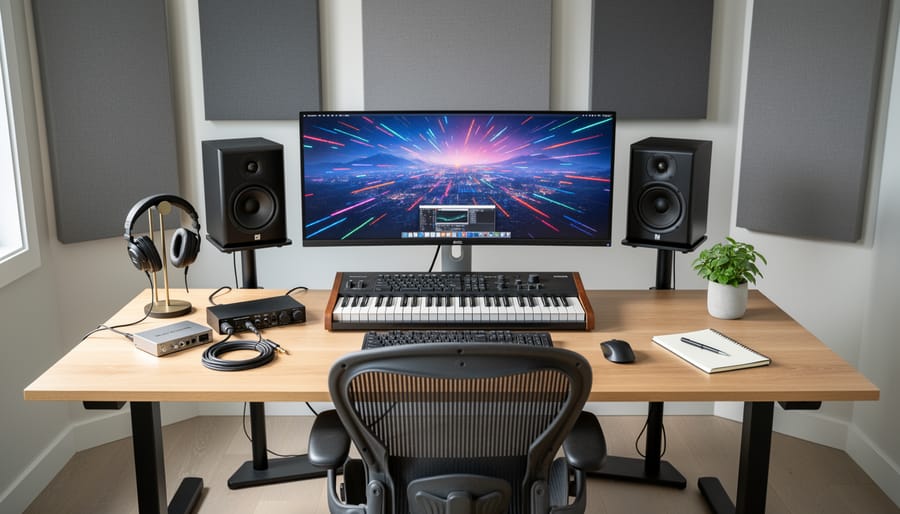
A regular desk holds your laptop and coffee mug. A production desk is built around the physical act of making music, with features designed to keep your hands on the instruments and your mind in the flow state rather than wrestling with cables or reaching awkwardly for gear.
The most obvious difference is rack space, those vertical slots measured in U (rack units, each 1.75 inches tall) where you mount audio interfaces, preamps, compressors, and other outboard gear at arm’s reach instead of stacking them precariously on shelves. This keeps your signal chain accessible and your studio floor clear. A keyboard tray slides out to position your MIDI controller at the right height for playing comfortably, separate from your computer keyboard and mouse surface. You’re not hunching over a cramped single level trying to trigger samples and adjust plugins simultaneously.
Monitor bridges elevate your studio speakers to ear height and angle them correctly for mixing, which matters more than most beginners realize. Proper speaker placement affects what you hear, and what you hear shapes every mix decision you make. Cable management systems, grommets, channels, velcro straps, route power and audio cables out of sight and prevent the tangled mess that inevitably happens when twenty connections snake across an open desktop.
The ergonomic layout follows office ergonomics guidance but adapts it for producers who work in a different posture than office workers. You’re leaning forward to twist knobs, sitting back to listen critically, reaching across to hit pads. Production desks position everything within that natural movement range so a six-hour session doesn’t wreck your back and shoulders.
These aren’t luxury features. They remove friction from your process. When your gear is organized, cables are managed, and everything sits where your hands expect it, you spend less time solving physical problems and more time making music.
Top Production Desk Options for Different Studio Setups in 2026
Best All-Around: Output Platform
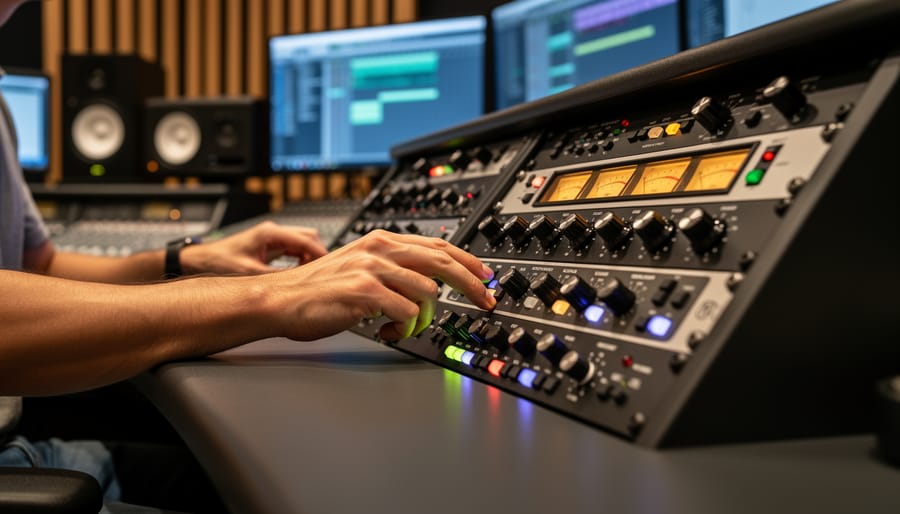
The Output Platform earns its reputation as the best studio desk for most producers through thoughtful design choices that accommodate real-world workflows. Built from 100% birch wood, it offers durability without the flimsiness common in cheaper particle-board alternatives. The 9U of rack space handles a decent collection of outboard preamps, compressors, and interfaces, while the 88-key tray slides out to accommodate full-size MIDI controllers without cramping your mouse and keyboard area.
What makes this desk particularly versatile is the monitor bridge, it positions your studio monitors at ear level for proper mixing perspective, which matters more than many beginning producers realize when they’re learning music composition software and refining their sound. The layout keeps everything within arm’s reach during long sessions, reducing the constant reaching and twisting that kills creative momentum. It’s not the cheapest option, but it covers the core needs of bedroom producers and small commercial studios alike without forcing compromises on rack space or controller access.
Budget-Friendly: On-Stage WS7500
The On-Stage WS7500 delivers the essentials without breaking the bank, making it a solid entry point for producers just setting up their first proper studio space. It gives you a dedicated keyboard tray and enough surface area for a computer monitor and audio interface, which covers the baseline for most bedroom production workflows. The build quality won’t match pricier options, but it holds gear securely and gets the job done when funds are tight. This desk proves you don’t need to drain your savings to create a functional production environment that keeps your controllers and monitors organized.
For Gear Collectors: Argosy Dual 15 and Gustav Sessiondesk
If you’re deep into how electronic music works and own hardware compressors, preamps, synth modules, and patch bays, you need serious rack space. The Argosy Dual 15 handles extensive outboard collections with dual rack bays that keep gear accessible during sessions without cluttering your work surface. It’s built for studios where analog processing matters and gear stays connected.
Gustav Sessiondesk offers a compelling alternative with 18U of rack space at a lower price point. That’s enough room for a solid collection of interfaces, preamps, effects units, and power conditioners while keeping everything in arm’s reach. If you’re building a hybrid setup mixing hardware and software, Gustav gives you expansion room without the premium Argosy pricing. Both options assume you’re past the laptop-and-interface phase and into the territory where routing through physical gear shapes your sound.
Minimalist and Custom Options
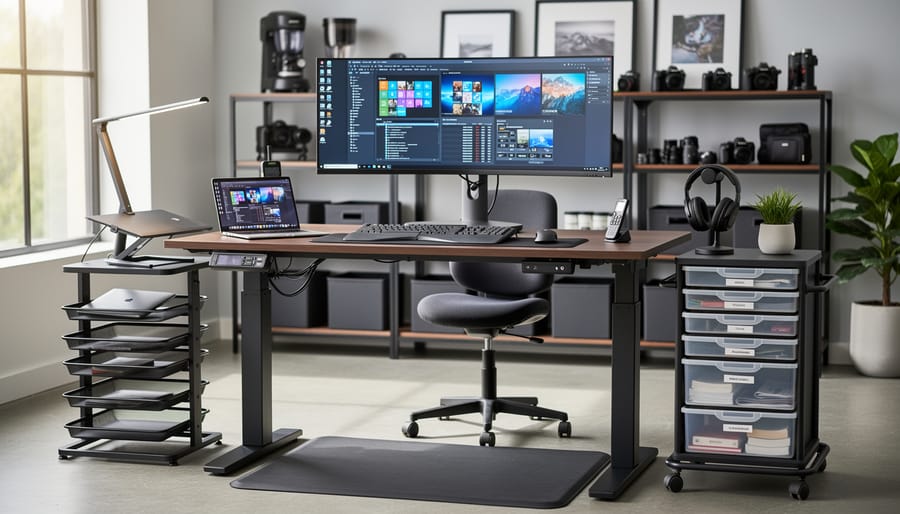
Not everyone needs dedicated rack space or elaborate keyboard trays. If you’re working with a laptop, audio interface, and maybe a compact MIDI controller, the Project 62 Loring Wood Writing Desk offers a clean, minimalist foundation you can adapt to your workflow. It’s a simple table that gives you surface area without presuming how you’ll use it, which makes it ideal for producers who prefer to keep things stripped down or build their own cable management and monitor positioning solutions.
For producers who want precise control over desk height and dimensions, the UPLIFT Custom Solid Wood Standing Desk lets you specify measurements that fit your exact space and posture preferences. You can switch between sitting and standing throughout long production sessions, and the custom sizing means you’re not compromising on width or depth to accommodate gear you actually use. It requires more upfront planning than grabbing an off-the-shelf production desk, but the payoff is a workspace built exactly how you need it.
What to Consider Before Buying Your Production Desk
Before you start comparing desk models or clicking add-to-cart, step back and audit your actual situation. The desk that works for a producer with three synths and a laptop won’t serve someone running a dozen pieces of outboard gear, and vice versa. Start by measuring your room, not just the wall length where the desk will sit, but the depth you can afford without blocking walkways or doors. Production desks run deeper than office furniture because they accommodate monitor placement and keyboard trays, so a setup that looks reasonable in photos might overwhelm a small bedroom studio.
Next, list every piece of gear you own and plan to acquire in the next year. Count your synths, MIDI controllers, audio interfaces, monitor speakers, and any rack-mounted units. If you’ve got two synths now but know you’ll add a drum machine and sampler soon, account for that. Consider whether you need rack space at all, many laptop-centric producers don’t, and if you do, how many units. This inventory determines whether you need something like the Gustav Sessiondesk’s 18U capacity or if a simpler surface works fine.
Think honestly about your workflow. Do you produce sitting for twelve-hour sessions, or do you prefer standing while sketching ideas? Are you constantly reaching for hardware knobs, or do you work mostly in-the-box with occasional MIDI input? Your mixing position matters too, if you’re serious about stereo imaging, you need a desk that positions monitors at the correct height and distance, which often means a bridge or stands. Cable access is less glamorous but crucial; desks with rear cutouts and management systems save you from crawling under furniture every time you patch something new.
Finally, set a realistic budget that includes not just the desk but accessories like monitor stands, cable organizers, and potentially a good chair. A $200 desk with a $300 chair beats a $500 desk with a $50 chair for long-term comfort. Remember that underground producers have made incredible records on kitchen tables, the desk supports your work, but it’s not the work itself.
Where to Find and Compare Studio Desks
Most major music retailers stock production desks, with Sweetwater carrying the widest selection of dedicated studio furniture. Their catalog includes established brands like Argosy, RAB Audio, Zaor, Gator, On-Stage, JamRacks, Middle Atlantic Products, Ultimate Support, Sound Anchors, and Steven Slate Audio. Each manufacturer approaches the problem differently, some prioritize modularity, others focus on rack space density or aesthetic minimalism.
When comparing options, look beyond marketing photos. Check exact dimensions against your room measurements, count the rack units if you have outboard gear, and verify the keyboard tray depth if you’re using 88-key controllers. User reviews from other producers often reveal real-world issues like wobbly monitor bridges or poorly positioned cable grommets that don’t show up in spec sheets.
Assembly is worth considering too. Some desks arrive flat-packed with cryptic instructions and require two people plus an afternoon. Others ship mostly assembled but weigh enough to strain your back getting them upstairs. If you’re not handy with an Allen key, factor that into your decision.
Common Questions About Music Production Desks
Do you actually need a specialized production desk, or can you just use whatever’s already in your room? It’s a fair question, especially when you’re starting out or working with limited funds. A regular desk can absolutely work if it fits your gear and keeps everything within reach, but production desks solve specific problems that start to matter once you’re serious about your workflow. The keyboard tray keeps your MIDI controller at the right height while your mouse and interface stay on the main surface. The rack space means your preamps and compressors aren’t scattered across the room. The cable management keeps you from spending twenty minutes tracing which XLR is plugged into what. If you’re mostly working in the box with a laptop and one interface, a sturdy regular desk is fine. If you’ve got synths, controllers, outboard gear, and monitors that need proper positioning, a production desk starts paying for itself in time saved and frustration avoided.
How much rack space do I actually need?
Count your current rack-mounted gear and add a few units for future acquisitions. Most producers find 6-12U sufficient, though gear collectors might want 15U or more like the Gustav Sessiondesk’s 18U capacity.
Are standing desks worth it for music production?
Standing desks let you switch positions during long sessions, which helps with fatigue and keeps your energy up. Options like the UPLIFT Custom Solid Wood Standing Desk work well if you value flexibility, though they cost more than fixed-height models.
Can I build my own production desk?
Absolutely, many producers start with basic furniture like the Project 62 Loring and add DIY rack rails, shelves, or monitor stands. It takes more effort than buying a ready-made desk but gives you exactly what you need for less money.
What’s the best way to handle cable management?
Look for desks with built-in cable trays or routing holes, and use velcro ties to group cables by type. Keeping power separate from audio cables reduces noise, and labeling everything saves you grief when troubleshooting.
The desk that works for someone tracking live bands with racks of preamps won’t necessarily suit a bedroom producer making beats with a laptop and a MIDI keyboard. Think about how you actually spend your time in the studio. If you’re constantly reaching for hardware synths, you need surface space and stability. If you’re mainly mixing and referencing, monitor positioning and ear-level ergonomics matter more. And if you’re writing album review examples or other music content between production sessions, a desk that accommodates both workflows makes sense. The right answer depends on your gear, your room, and how you make music.
The right production desk organizes your gear, keeps your posture in check during those deep-in-the-mix sessions, and removes friction between you and your creative flow. But it’s worth remembering that countless independent artists have crafted brilliant tracks from makeshift setups, a folding table, a cramped bedroom corner, whatever worked. The desk matters because it supports how you work, not because it defines what you’re capable of making.
Choose based on your actual workflow, not an aspirational vision of someone else’s studio. Measure your space, list your gear, and think honestly about how you produce music. Do you reach for hardware constantly or live mostly in the box? Do you mix standing up or hunker down for hours? A desk that matches your real habits will serve you better than the flashiest rig that fights your process.
Function beats aesthetics every time. The music you make is what people will hear, not the furniture you made it on.